Regimental history
The 2nd Wisconsin and the Iron Brigade
No Union infantry regiment lost a higher percentage of its men killed in battle than the 2nd Wisconsin. This is the regiment our company exists to remember.
Camp Randall, 1861
The companies that became the 2nd Wisconsin Volunteer Infantry were raised across the state in the spring of 1861 and drilled at Camp Randall in Madison. Company E — the "Oshkosh Volunteers" — came from the logging camps, farms, and river towns of Northeastern Wisconsin.
The regiment mustered into United States service on June 11, 1861. Its men had answered a ninety-day call but enlisted instead under Lincoln's three-year call, making the 2nd one of the earliest long-service regiments raised in the West. It left for Washington later that same month and was in combat within six weeks.
The Black Hat Brigade
The 2nd Wisconsin was brigaded with the 6th and 7th Wisconsin and the 19th Indiana — the only all-Western brigade in the Army of the Potomac — with the 24th Michigan joining after Antietam. Instead of the usual fatigue cap, its men wore the tall black Model 1858 Hardee dress hat, plus frock coats and white gaiters. Confederate troops learned to recognize the silhouette and called them the Black Hat Brigade.
After the brigade fought its way up Turner's Gap at South Mountain on September 14, 1862, the name changed. The story handed down is that a Union commander watching the assault — most accounts say George B. McClellan — said the men must be made of iron. From that day they were the Iron Brigade. The exact wording and the officer who said it come from postwar recollection rather than a battlefield record, but the name stuck for good reason.
Where the regiment fought
July 21, 1861
First Bull Run
One of the few Union regiments to press the assault on Henry House Hill in the war's first major battle. The 2nd went in wearing state-issue grey coats and was fired on by both sides in the confusion — an early, costly education.
August 28, 1862
Brawner's Farm (Gainesville)
The brigade's making. Standing in the open at close range against Stonewall Jackson's veterans, the Wisconsin and Indiana men refused to break. Col. Edgar O'Connor of the 2nd Wisconsin was killed here.
August 29–30, 1862
Second Bull Run
Engaged again days later during the Union withdrawal, covering the retreat of a beaten army.
September 14, 1862
South Mountain
The brigade fought its way up Turner's Gap against a defended slope. It is from this action that the name "Iron Brigade" is traditionally dated.
September 17, 1862
Antietam
Part of the I Corps attack that opened the bloodiest single day in American history, fighting through the Cornfield and past the Miller farm. Brigade losses were severe enough that the 24th Michigan was added afterward to bring it back to strength.
December 1862 – May 1863
Fredericksburg and Chancellorsville
The I Corps saw limited direct action in both campaigns, holding positions on the Union left and in reserve.
July 1, 1863
Gettysburg
The 2nd Wisconsin was the first Union infantry regiment engaged at Gettysburg (see below). It effectively ceased to exist as a full regiment by the end of that morning.
May 1864 onward
The Wilderness, Spotsylvania, Petersburg
By Grant's Overland Campaign the 2nd was a remnant of a regiment, still in the field. Non-veterans mustered out in June 1864 as their three years expired; the remaining veterans and recruits were consolidated into the Independent Battalion, Wisconsin Infantry, which served on through the siege of Petersburg.
The first shots at Gettysburg
On the morning of July 1, 1863, the Iron Brigade came up the Emmitsburg Road at a run and went straight into Herbst Woods on McPherson's Ridge against Confederate brigades advancing from Herr Ridge. The 2nd Wisconsin was the first Union infantry regiment engaged in the battle.
Maj. Gen. John F. Reynolds, commanding the I Corps, was personally placing the 2nd Wisconsin at the edge of those woods when he was shot from the saddle and killed — the highest-ranking casualty of the battle. Minutes later, in the fighting inside Herbst Woods, the Iron Brigade overran and captured Confederate Brig. Gen. James J. Archer, the first general officer taken prisoner from Lee's army since Lee assumed command. Most accounts credit the 2nd Wisconsin's front, though the men of the 6th and 19th were in the same fight.
The regiment went into those woods with roughly 300 men and lost about 233 of them in a single morning — commonly recorded as 26 killed, 155 wounded, and 52 missing or captured. Col. Lucius Fairchild lost an arm; Maj. John Mansfield was wounded; command fell to a captain. Fairchild later became governor of Wisconsin.
The cost, in numbers
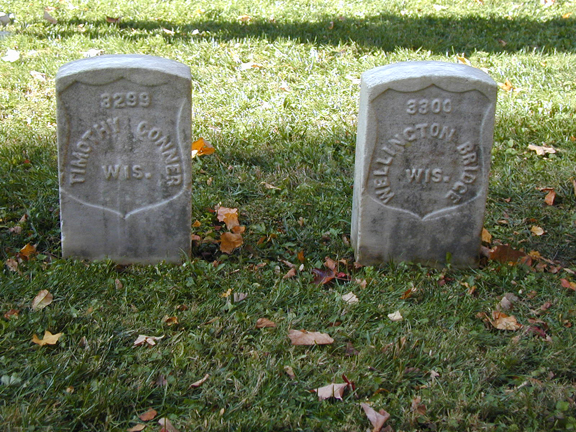
Another 77 men died of disease, for roughly 315 deaths out of 1,203. In William F. Fox's Regimental Losses in the American Civil War (1889) — still the standard reference — the 2nd Wisconsin stands at the top of the Union list for percentage of enrolled men killed or mortally wounded in action. That is a narrower and grimmer statistic than "most casualties": larger regiments lost more men in total. No regiment lost a greater share of its own.
Sources
- National Park Service — 2nd Regiment, Wisconsin Infantry
- Wisconsin Veterans Museum — 2nd Wisconsin Infantry Regiment
- William F. Fox, Regimental Losses in the American Civil War (1889)
- American Battlefield Trust — Gettysburg, July 1, 1863
Keep the regiment's memory in the field
Company E has portrayed these men since 1990 — at reenactments, parades, classrooms, and museums across Wisconsin. Come see us, or fall in with us.